translate for your audience
When you’re the one working with data, you likely know it better than anyone else. While this is great—it puts you in a fantastic position to help others derive value from it—it can also be problematic. Because when we’re close to a topic, it can be hard to detect when specialized language, acronyms, and abbreviations that all seem super obvious to us, can totally obfuscate our message. (Mike writes about this phenomenon, known as the curse of knowledge, in Chapter 8 of Before & After.)
Consider the following example. Take a moment to scan the slide below and see if you can quickly identify the main takeaway.
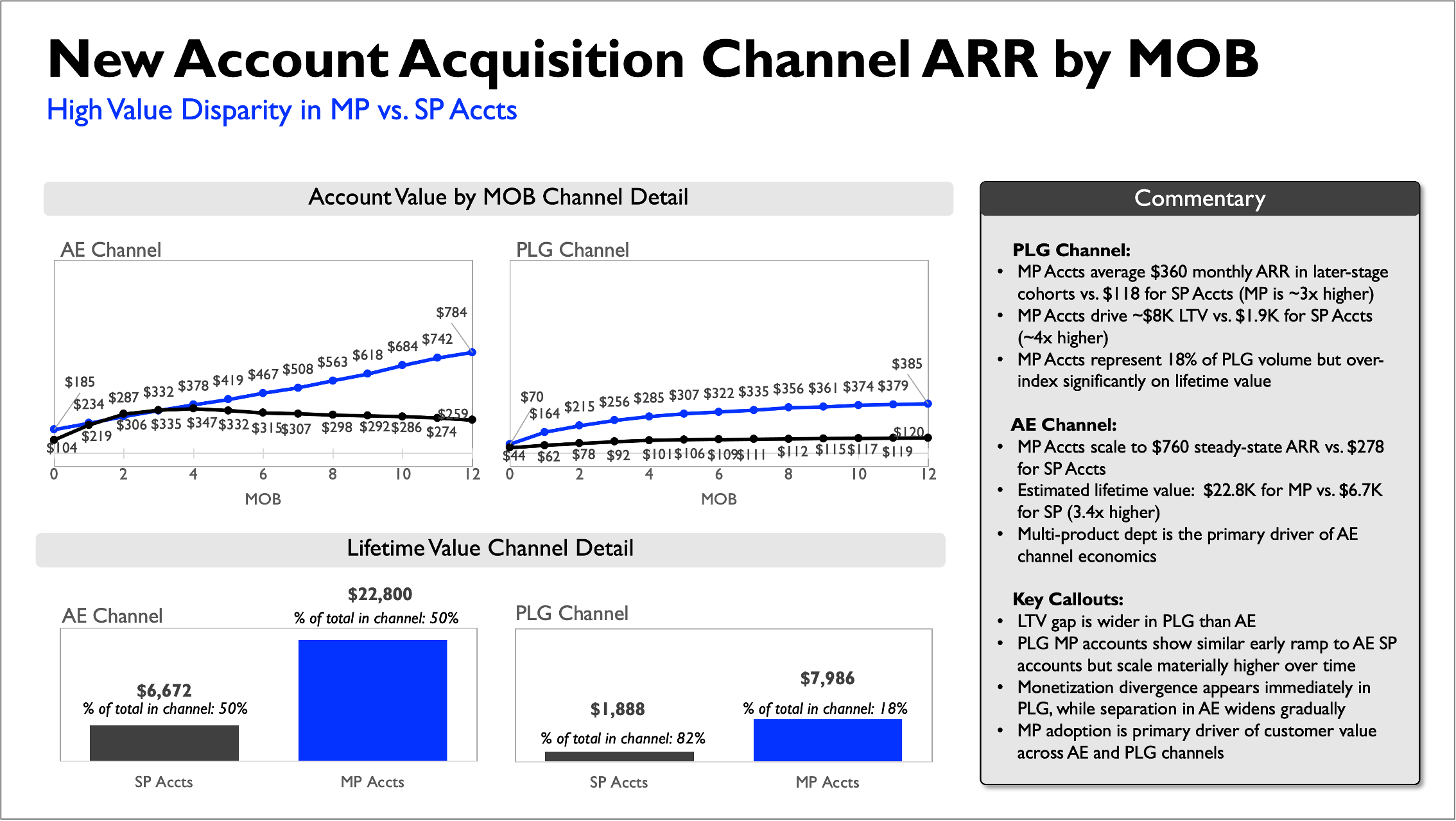
This slide summarizes performance for a SaaS (software as a service) company, showing how revenue from newly acquired customers grows over time based on how they were acquired and how many products they adopt.
Before we can start interpreting the data, we have some serious decoding work to do! There are numerous acronyms and abbreviations that are used repeatedly across the graphs and commentary.
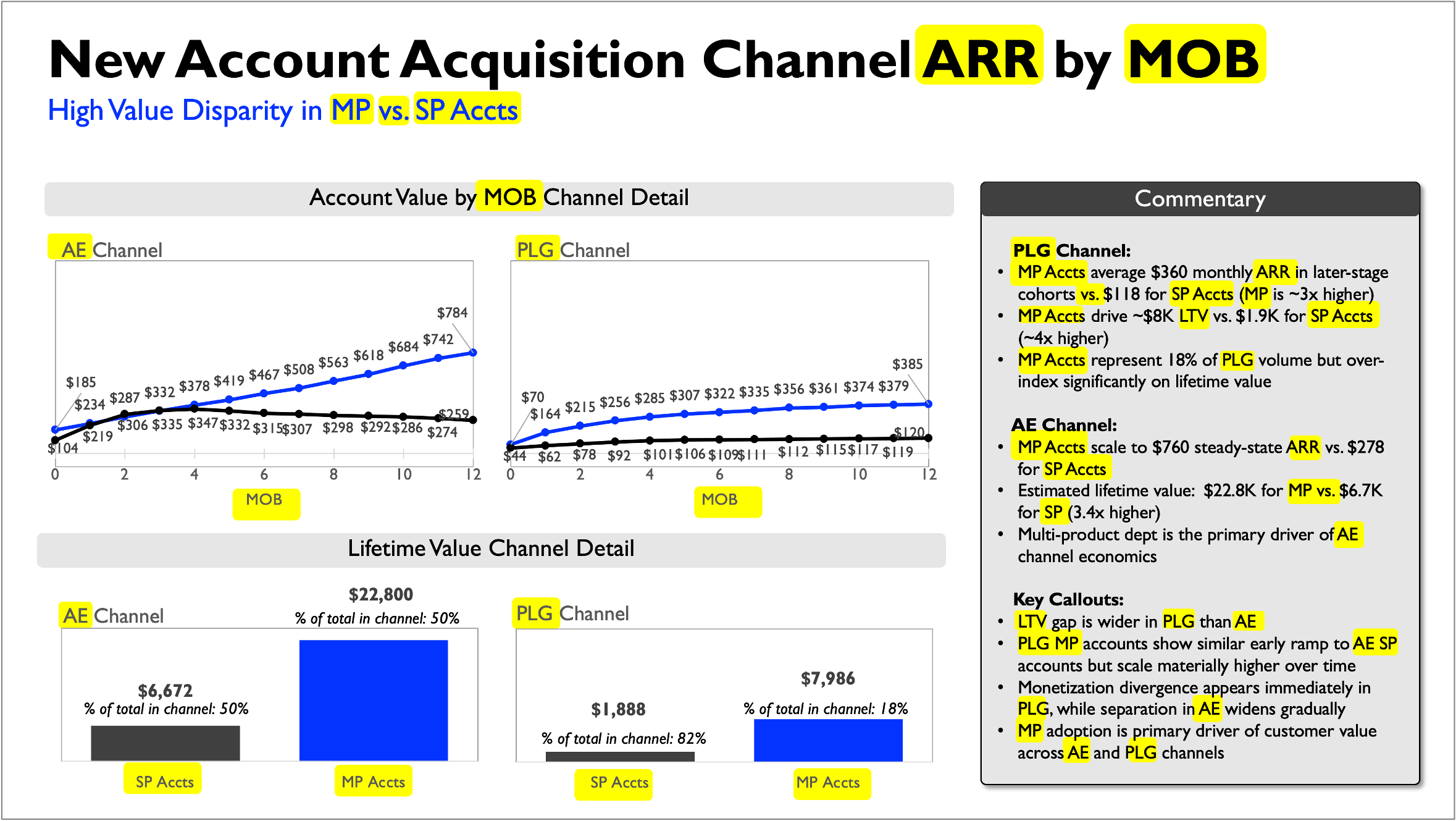
By my quick count, there are more than 50 acronyms and abbreviations on this single slide!
Let’s start by defining the main ones:
ARR: annual recurring revenue
MOB: months on book (time since account opened)
AE: account executive, or sales-assisted channel
PLG: product-led grown, or self-serve channel
MP: multi-product customers
SP: single-product customers
LTV: lifetime value
Accts: accounts
For the people who produced this slide, these terms likely feel perfectly normal. For those outside that team—even someone from another part of the business—this slide requires a ton of translation before we have any chance of understanding the message.
Speaking of the message, if we refer back to the subtitle of the slide, we can learn the core insight: High Value Disparity in MP vs. SP Accts.
In plain language, this means: customers who adopt multiple products generate far more value than customers who use only one.
That key insight is buried under layers of shorthand and reporting language.
I reworked the slide with this insight in mind, articulating it succinctly at the top. I also defined acronyms, spelled out full words, and stated things simply. I condensed the data that was previously in four graphs to two, making it easier to compare each metric across all customer segments. I organized titles and commentary together with each graph to make it easier to connect the words to the data that support them. I added a discussion topic to help direct next steps.
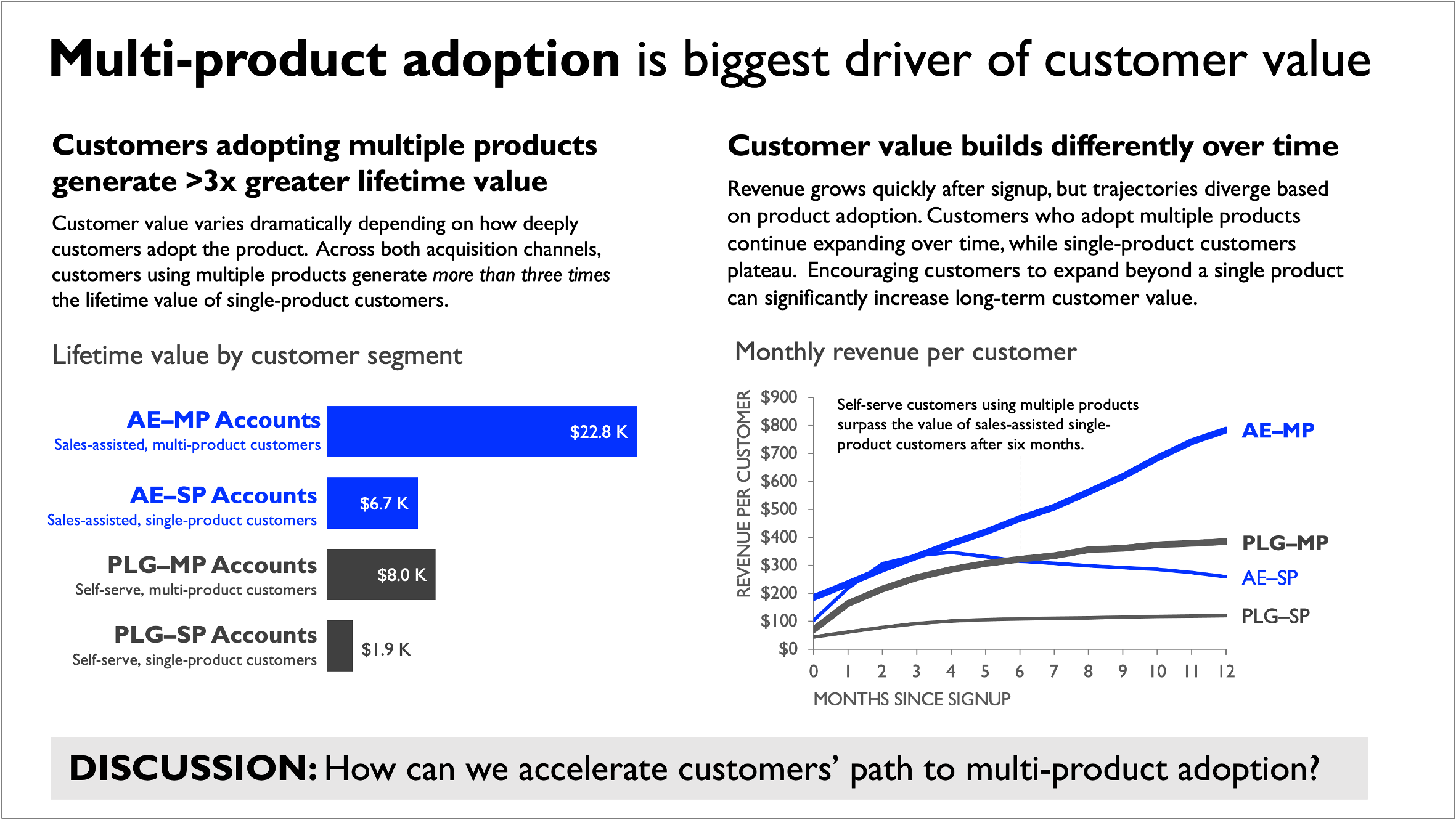
The original slide might have worked perfectly well in a regular report. Reports often prioritize completeness and precision.
But when you need people to truly understand something and pay attention, it’s worth taking the time to translate. This means translating:
acronyms into language your audience understands
jargon into meaning
analysis into a clear takeaway
The challenge isn’t the data—it’s the translation.
When we’re deep in our own analysis, it’s easy to assume that others speak the same language we do. But our audience doesn’t live inside the metrics, acronyms, and reporting structures. If we want them to engage—and act—we have to translate first.
This is exactly the kind of “aha” moment we see in our storytelling with data team trainings, which are customized around examples from your team’s own work. Often the biggest breakthroughs come when people see how small changes—like clarifying language, focusing the message, and simplifying the visuals—can completely transform how their data is understood.