be careful using questions as slide titles
The importance of an effective slide title cannot be overstated. Positioned in prime real estate at the top of the page, it is often where an audience’s eyes will land first. With that in mind, it is worth investing time to craft a title that introduces the content below and establishes a clear purpose. Too often, this valuable space is used for purely descriptive statements. Let’s look at an example.
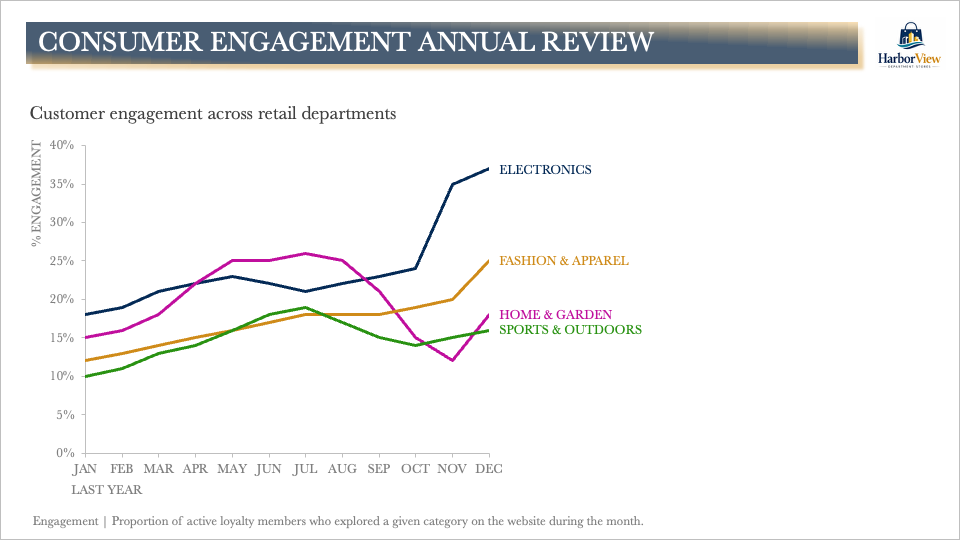
With the title “CONSUMER ENGAGEMENT ANNUAL REVIEW,” an opportunity is missed to indicate what truly matters with the slide, which shows customer engagement for a department store across several retail areas. The audience is left to determine independently what deserves attention. This can be improved by making a key observation about the data. Doing so primes the viewer to look for evidence of that statement in the chart.
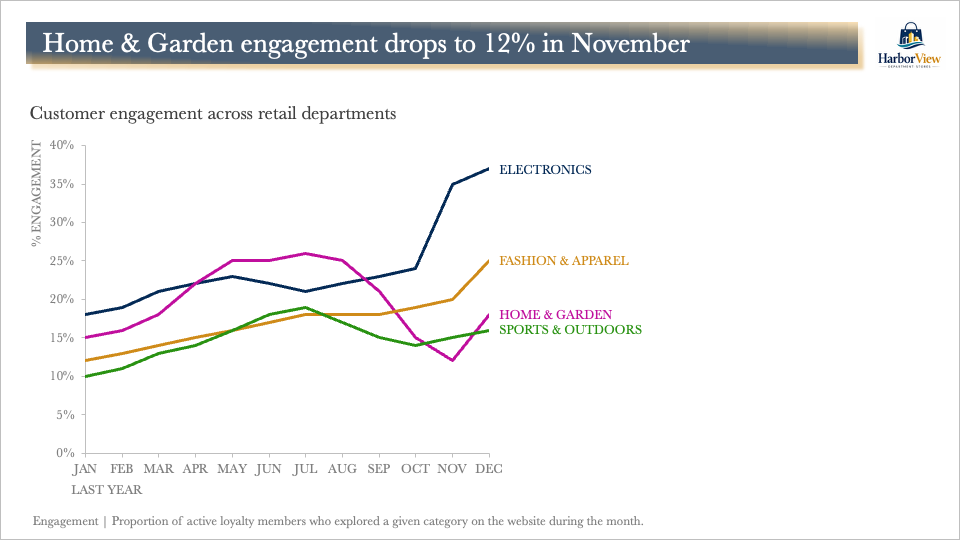
This is better. The most important insight from the visual, a concerning decrease in engagement for the Home & Garden area in November, is now clearly communicated. Yet, committing to a single interpretation of the data can feel uncomfortable. Perhaps this is part of the reason we sometimes see slide titles posed as questions.
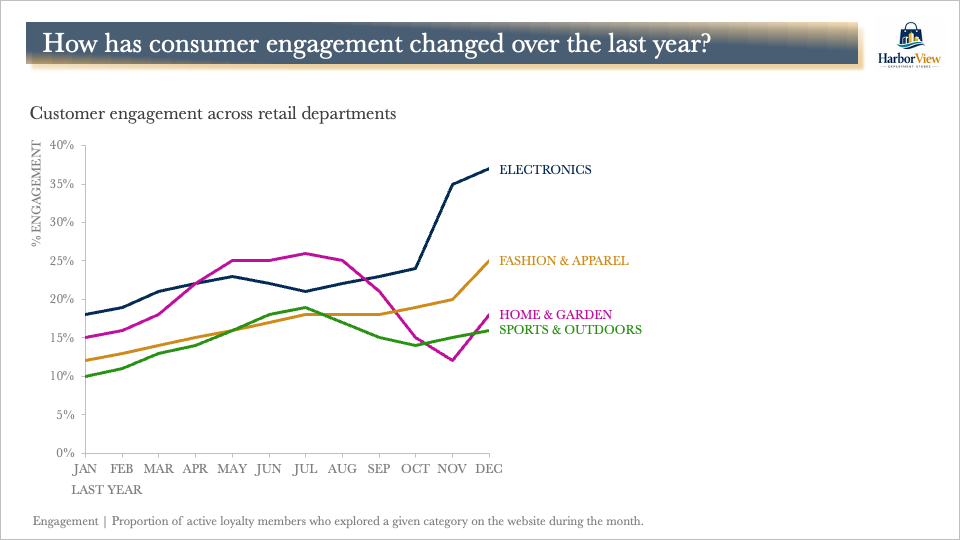
At first glance, this feels engaging. A question invites curiosity and perhaps debate. But good intentions can introduce complications. When faced with a question, the audience may:
Mentally attempt to answer it: Now those present have been asked to think. That can be engaging—but it’s also demanding. They’re trying to answer the question, interpret the chart, and listen to you at the same time. Not all of those tasks can happen simultaneously. Most likely, what suffers is attention to the presenter.
Interrupt the presentation: Questions create a knowledge gap that the brain wants to fill. This can be powerful, but only if the answer comes quickly and clearly. More outspoken participants may try to answer immediately, steering the discussion in a direction not planned or practiced.
Come to the wrong conclusion: In trying to answer the question, the audience might need to make assumptions or draw their own conclusions. This risks putting them on a different path from the intended narrative.
Undermine presenter credibility: Posing a question can unintentionally signal uncertainty, implying that a firm conclusion has not yet been reached or the presenter isn’t confident in the insight. A heading like “Are our campaigns effective?” may leave those in attendance wondering whether there’s a clear answer coming at all.
Instead, consider using an active takeaway title that explicitly states the key message—and signals how the information should be interpreted or acted upon. In the case of our example, the promotional content for the critical Black Friday period wasn’t as extensive as it could have been, resulting in consumers exploring competitors' stores for deals. A further revision of our slide demonstrates the effect this clarity of message can have.
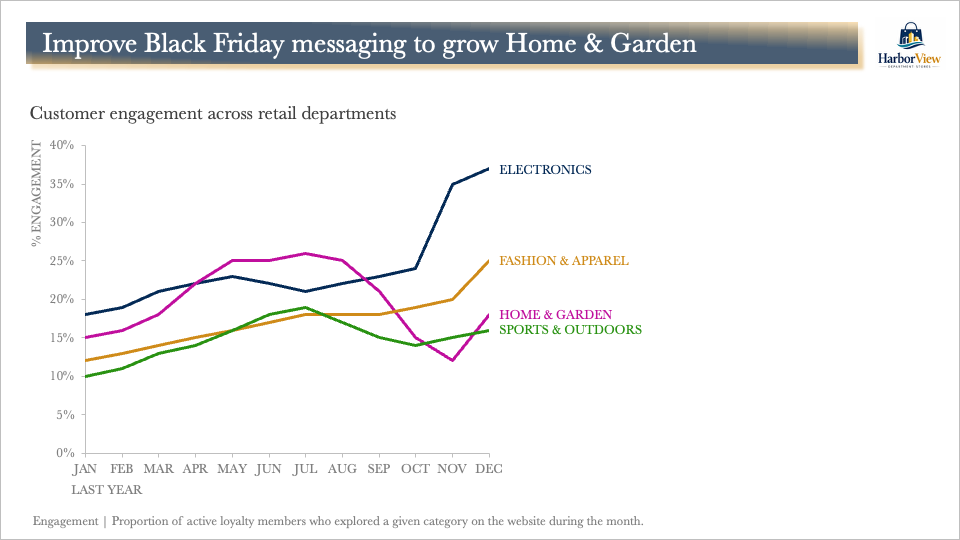
With a clear purpose established for the slide, the added benefit is that the graph can now be revised to tie to the statement visually. Let’s iterate one final time.
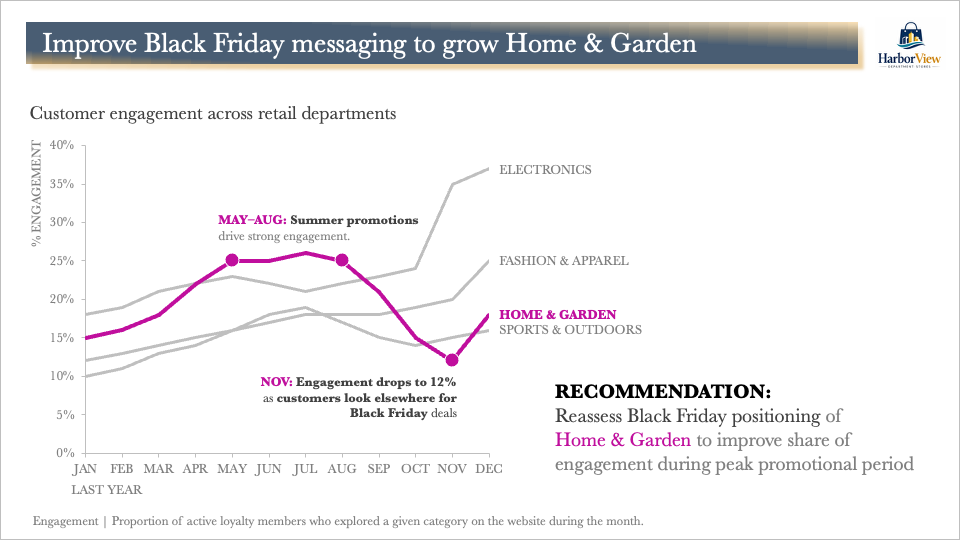
In this version, color is used sparingly to emphasize the Home & Garden line, annotations (plus sparing data markers) have been added to highlight the key moments, and a clear recommendation clarifies what to do next. The meeting can now focus on discussing the proposed action rather than debating what the data means.
Slide titles framed as questions are more engaging than descriptive ones. Used deliberately, they can spark curiosity. But they can also divide attention, introduce confusion, or imply uncertainty. Instead, identify the main purpose of the slide and craft a takeaway title that states it clearly, ideally signalling the appropriate course of action. And in doing so, you can be confident the audience immediately understands the point of the communication and how to move forward.
If you are interested in learning more about the importance of words when creating slides, explore past articles for additional examples: transforming slide titles and vertical logic. Or if you’d like to practice crafting a compelling takeaway title, check out this community exercise.