SWD + AI: start with context

This post is part of the SWD + AI series—practical guidance for using AI as a thought partner across the various stages of your data storytelling work. Explore all of our AI resources.
Nearly everything we teach at SWD—every book, workshop, makeover—starts from the same place: context. Before you choose a chart type, open a slide deck, or think about color or layout, you need to understand who your audience is and what you need them to know or do. This is the foundation of effective data communication. It always has been.
Of course, by the time you’re thinking about communication, there’s a good chance you’ve already done significant work to get there: exploring your data, identifying patterns, and surfacing key insights. You may have even used AI to help with that. But exploratory work and explanatory work are different things. Knowing what the data says is not the same as knowing how to communicate it. That transition—from analyst to storyteller—is where context becomes essential.
This is an area where AI can add immense value as a thought partner: right at the beginning, before you’ve invested time creating anything. AI can push back on vague thinking, ask questions, introduce angles you haven’t considered, and help you stress-test your framing while it’s still easy to change. Unlike asking a colleague to carve out time in their day, AI is available on your schedule; it’s a willing thought partner whenever you’re ready to think things through.
But it can only do that if you come prepared. The quality of the conversation depends entirely on the context you bring to it. That starts with the work SWD has always taught: understanding your audience, clarifying what’s at stake, and forming a clear point of view before you communicate anything. In this post, we’ll work through all of that, using the Big Idea worksheet as our guide and AI as our thought partner.
Working with AI: start with context
The Big Idea is a single sentence that captures your point of view and conveys what’s at stake for your audience. The Big Idea worksheet (a free single-page download) is a structured way to get there. You have a couple of options when it comes to how to use AI here. One is to complete the worksheet and provide it as a starting point. Alternatively, you can work through it section by section, using AI to pressure-test your thinking as you go. Start with your audience, then the stakes, and finally the Big Idea. The worksheet provides the structure; AI can help you sharpen each piece as you go.
Before getting to more detailed guidance and an example, let’s review some potential pitfalls of working with AI to understand your context and form your Big Idea.
Things to watch out for:
AI doesn’t know your audience, your data, or your organization like you do—if you give it generic descriptions, you’ll get generic responses. If you are unsure about the specifics, talk to a human first; AI can’t replace the firsthand knowledge that comes from actually knowing the situation and people involved.
AI may generate a confident-sounding Big Idea that isn’t actually yours—watch for moments where you’re adopting AI’s framing rather than refining your own.
AI tends to broaden rather than narrow—it may suggest covering more ground than you need. SWD teaches ruthless focus; use AI to sharpen, not expand.
Be mindful of what you share—avoid including sensitive data, personally identifying information, or confidential business details in your prompts.
The following example prompts are designed to get you started. Be sure to adapt the language and instructions to fit your specific situation and needs.
Before you begin: set the stage
I am going to work through the Big Idea worksheet from storytelling with data (SWD)—it’s a framework for clarifying who your audience is, what’s at stake, and your core message before creating any communication. I’ll share my thinking one section at a time and ask for your input as I go.
As you help me, please keep these SWD principles in mind:
Audience analysis should go beyond who they are to consider what they care about, what biases they bring, and what would motivate them to act
Effective data communication puts the audience’s needs ahead of the analyst’s findings
The Big Idea should be a single sentence that articulates a clear point of view and conveys what’s at stake for the audience
Your role throughout our conversation is to be a thought partner and help me pressure-test my thinking. Help me think more clearly about who I’m communicating to and what they need. In particular, I’d like you to:
Ask clarifying questions before giving feedback
Surface blind spots and what may be missing or unconsidered
Suggest additional angles I may not have considered
Identify potential risks or weaknesses in how I’m framing the communication
Avoid jumping straight to rewriting or completing things for me—help me think more clearly so I can make better decisions myself
To give you helpful context, here’s a brief description of my project: [2–3 sentences describing what you’re working on, who you need to communicate to, and what you hope to achieve]
Does that make sense? Confirm you understand, and then I’ll share my first section.
Potential prompt 1: who is my audience?
I’m working through the audience section of the Big Idea worksheet. Here’s what I have so far: [fill in the following bullets, or share an image of the completed audience section of the Big Idea worksheet]
The primary groups or individuals I need to communicate to: [list names and/or roles or groups]
If I had to narrow to a single person, it would be: [name/role and why]
What my audience cares about: [list]
The action I need my audience to take: [describe]
Review what I’ve shared and help me think through:
Does it seem like I’ve identified the right primary audience, or is there a case for thinking about this differently?
For each person or group, what might they care about that I haven’t listed?
Is the action I’m asking for clear, realistic, and sufficiently specific?
Before offering feedback, ask me any questions that would help you give better input.
Potential prompt 2: what is at stake?
I’m now working through what is at stake. Here’s what I have: [fill in the bullets below, or share an image of the completed stakes section of the Big Idea worksheet]
The benefits if my audience acts in the way I want them to: [list]
The risks if they do not: [list]
Based on what you know about my audience and what they care about, help me think through:
Are these benefits and risks genuinely meaningful to my specific audience, or do any feel too generic?
Which benefits or risks are likely to resonate most strongly given their priorities and concerns?
What stakes might matter more to them that I haven’t listed?
What might I be overlooking, assuming, or oversimplifying?
Which of these are most essential to work into my Big Idea?
Before offering feedback, ask me any questions that would help you give better input.
Potential prompt 3: form my Big Idea
I’m now ready to craft my Big Idea—a single sentence that articulates my point of view and conveys what’s at stake for my audience.
My Big Idea: [type draft sentence, or share an image of the completed Big Idea section of the Big Idea worksheet]
Help me think through:
Does it clearly articulate a specific point of view, or does it read as neutral, vague, or descriptive?
Does it convey what’s genuinely at stake for my audience?
Is it a complete, single sentence? If not, can you suggest ways to wordsmith?
Suggest 2–3 possible refinements that keep my original intent but improve clarity, relevance, or resonance.
Before offering feedback, ask me any questions that would help you give better input.
To see how this all comes together, let’s walk through an example.
In practice: start with context
To bring these ideas to life, I’ll introduce a scenario that we’ll revisit in each post in this series. It’s inspired by a real-world situation, however the details have been anonymized.
Imagine that I am a People Analytics Manager at a mid-sized consulting firm. I’ve been asked to form and share my data-informed perspective on whether the company’s hybrid work policy is effective. My team has undertaken a thorough analysis, from correlating performance ratings with in-office attendance patterns to examining collaboration network data and attrition trends. What the data reveals is more nuanced than a simple yes or no—and our recommendation, moving from the current one-size-fits-all policy to a differentiated approach, needs to land with a leadership team that has differing opinions and goals.
This is precisely the type of situation where AI as a thought partner can add value: the audience is complex and the consequences of getting it wrong are significant. Getting the framing right before I start building any content should both make the rest of the process more efficient and help lead to better outcomes. So rather than jumping in and building graphs and slides, I began working through the Big Idea worksheet with my AI partner, Claude. (The prompts in this post are designed to work across tools—feel free to use whichever you prefer.)
First, I set the stage by copying and pasting the before you begin context shared previously, plus the following short description of my project:
I am a People Analytics Manager at a mid-sized consulting firm. My team has completed an analysis of our hybrid work policy—examining performance ratings, collaboration patterns, and attrition trends. We have a recommendation to move from our current approach (three days in office, two days remote for all employees) to a differentiated approach based on role and team type. I need to communicate this to a leadership team with divided opinions and real stakes in the outcome.
After Claude confirmed it understood the setup, I went analog. I printed out the Big Idea worksheet and spent a few minutes completing the top section, Who is your audience? I could have turned straight back to AI and started typing, but didn’t let myself. Going analog first is something I recommend generally: it helps ensure your initial thinking is genuinely your own, and physically putting pen to paper slows you down in useful ways, preventing you from anchoring too early to AI’s perspective.
Here’s what I wrote:
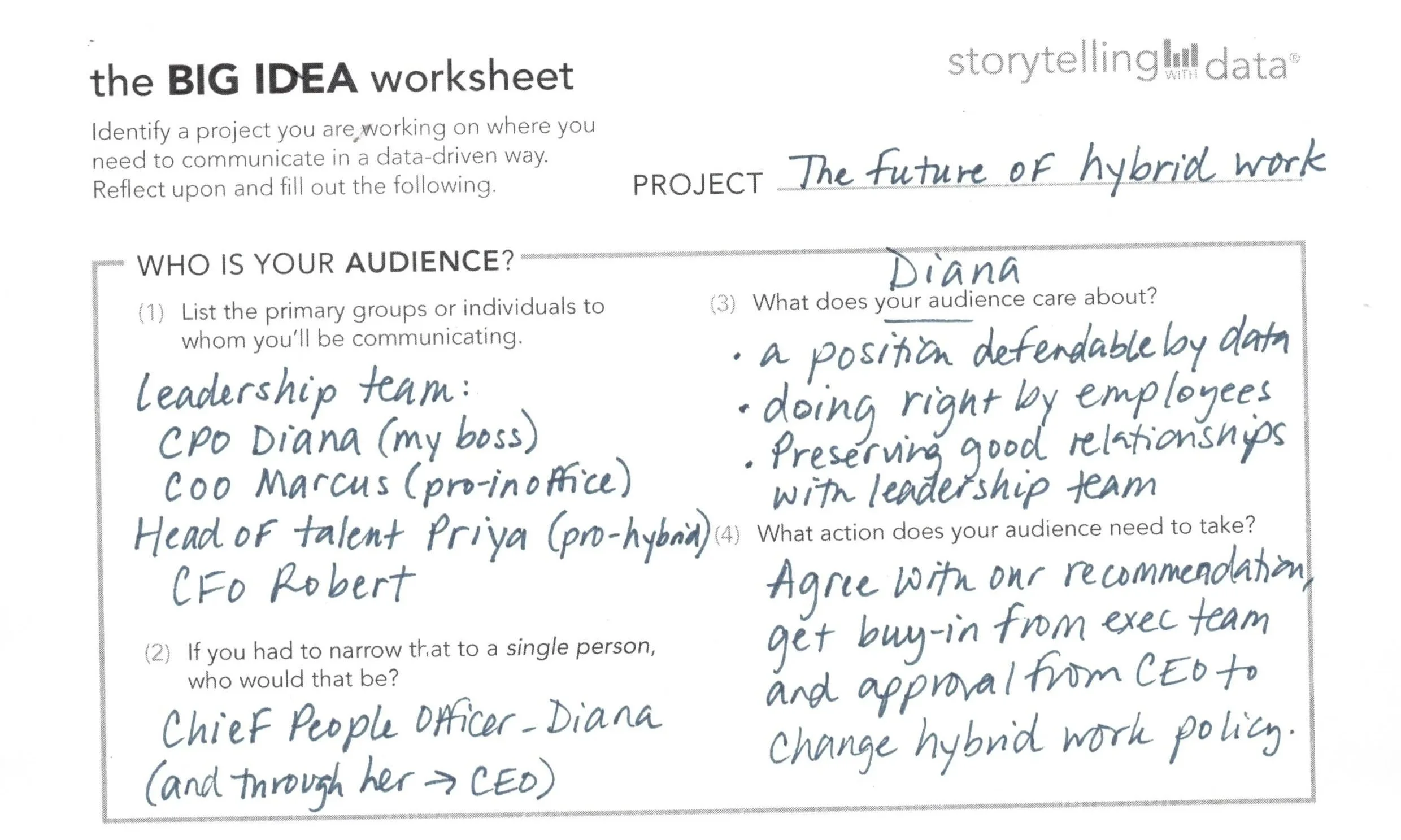
Using potential prompt 1, I shared this image with AI and asked whether I’d identified the right primary audience, what each person might care about that I hadn’t listed, and whether my requested action was specific enough.
Before addressing those, Claude had some initial questions for me:
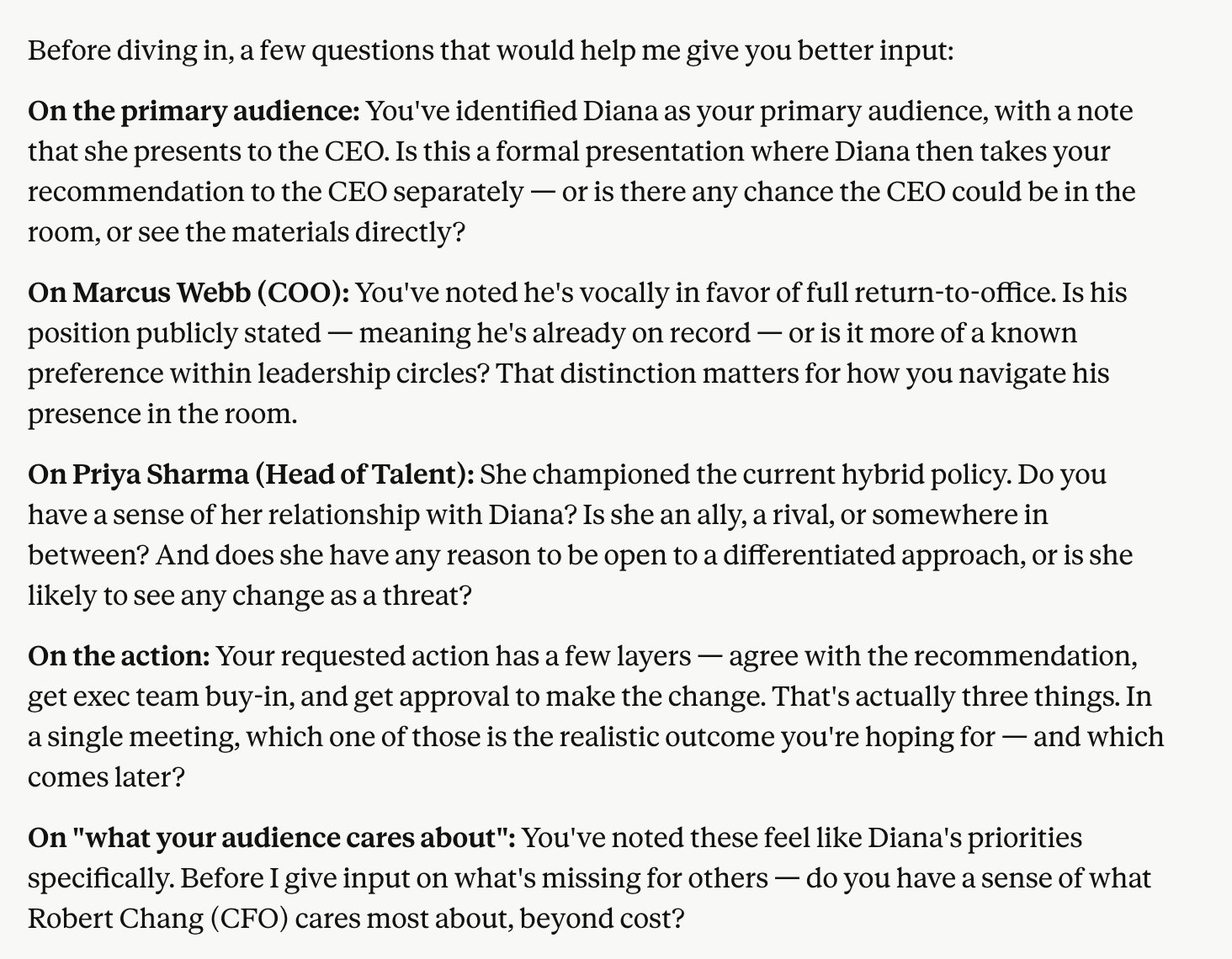
Simply having to articulate answers to these questions was clarifying. I responded that I would meet with Diana first to get her comfortable with the recommendation and supporting analysis, after which point she will present it to the entire leadership team, including the CEO.
It was helpful to recognize that I framed things mainly in terms of what Diana cares about, when really I will need to be addressing others’ potential concerns as well. Priya, for example, likes to refer back to outdated data on how much employees value a hybrid work environment—she’s convinced that we won’t be able to hire the talent we need if hybrid isn’t an option. The question about Robert was also useful, because he cares especially about real estate costs, which the differentiated policy we’re recommending will actually help reduce.
Before Claude pointed it out, I hadn’t realized there were three distinct actions embedded in what I wrote for that section. I’ll need to get Diana’s buy-in ahead of the meeting that we’re ultimately preparing for. So the single key action is leadership team buy-in (which should lead to CEO approval).
These initial questions were valuable for helping me think about the specifics of the situation in greater depth. After responding to the individual questions, here was the feedback on my audience section:
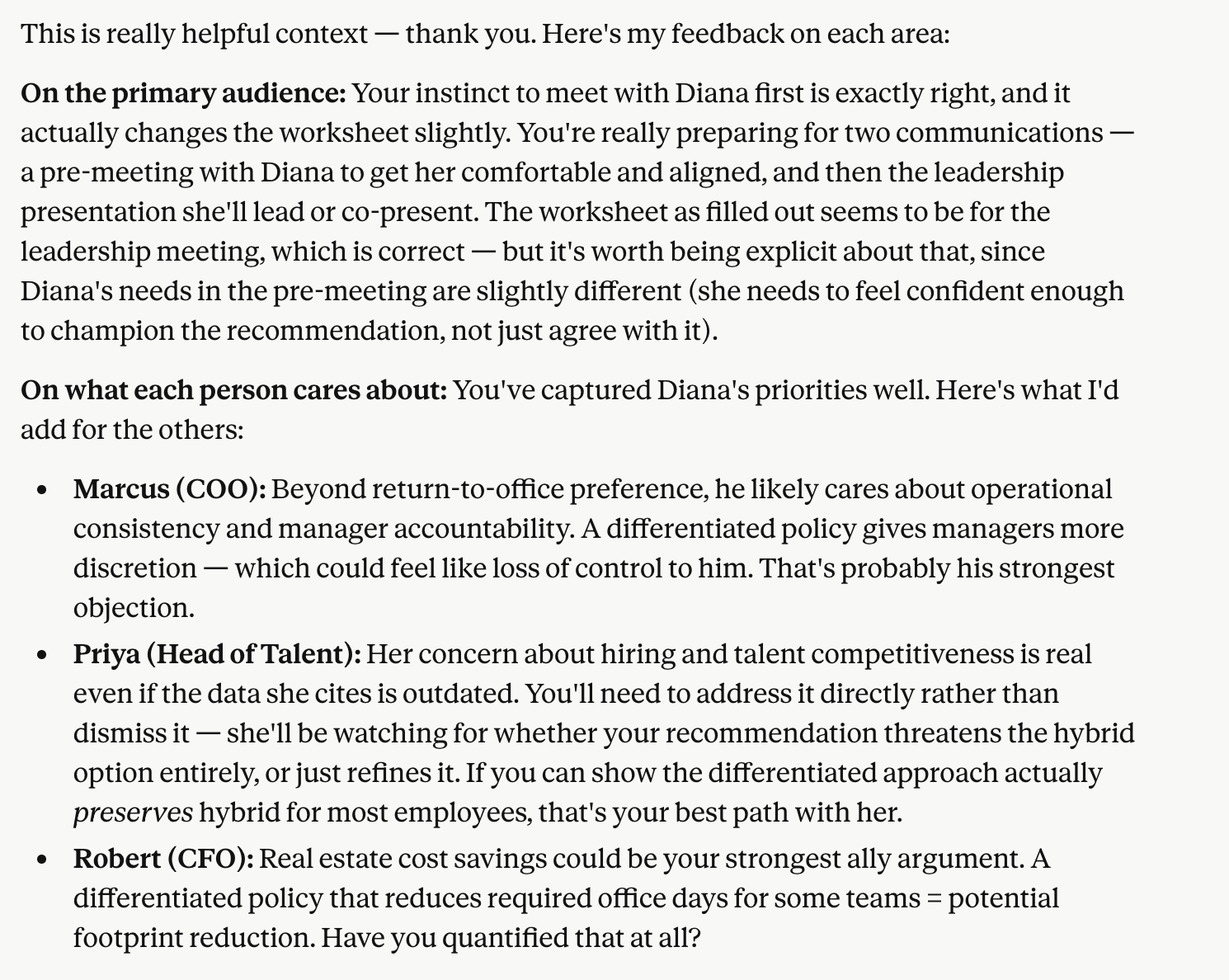
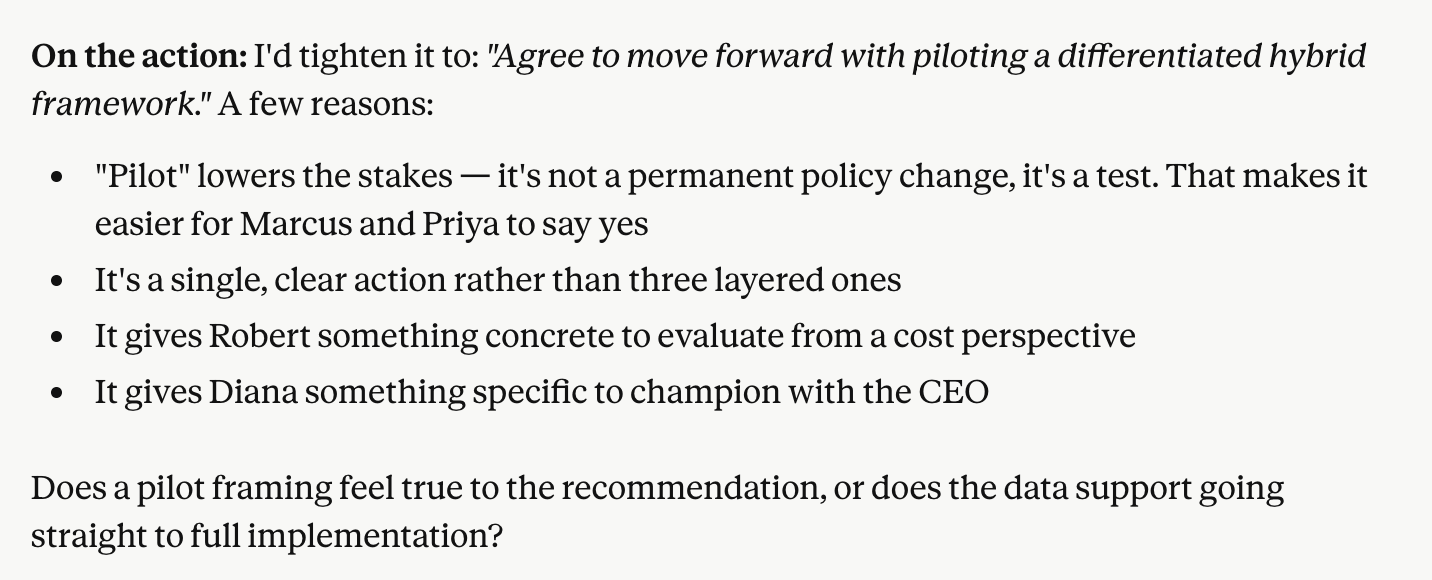
Reframing as a pilot is an excellent idea—and not something I had considered previously. Not only will that likely feel less threatening to those who might be against a change, but I anticipate it will also feel more comfortable for Diana to put forward to the leadership team.
With a clearer understanding of my audience and the action I want them to take, I moved on to the second section of the Big Idea worksheet, What is at stake? I thought about what our analysis had revealed in light of what each audience members cares about to create the following lists.
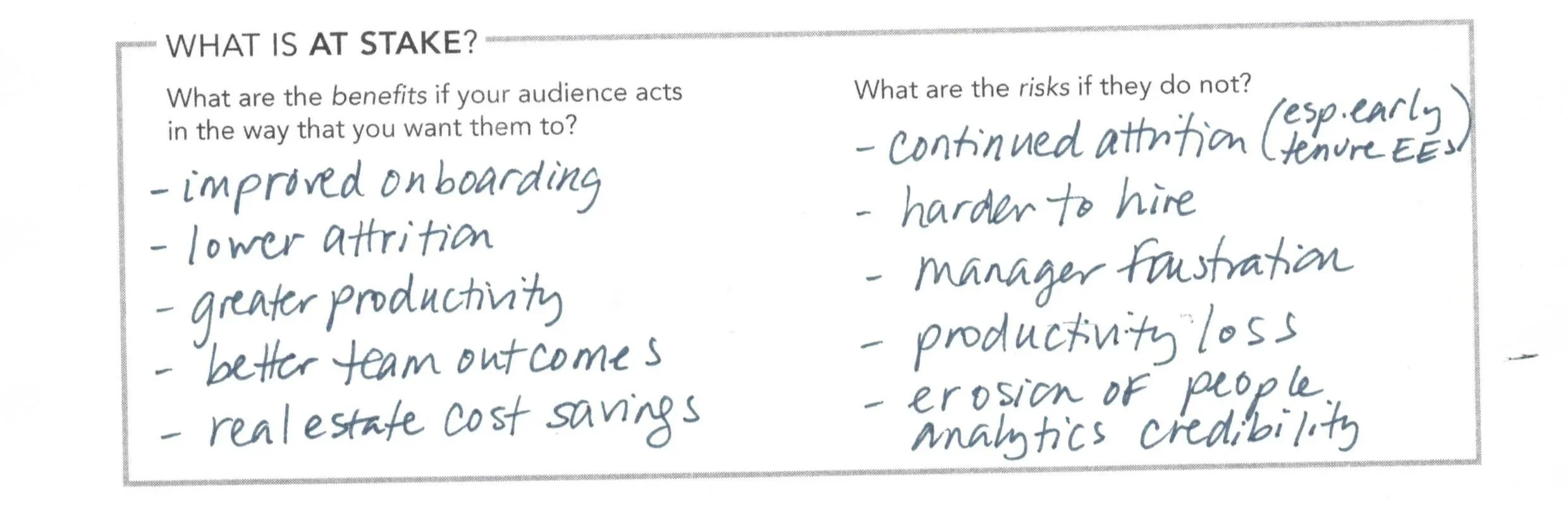
Next, using potential prompt 2, I shared these benefits and risks with Claude and asked whether they were genuinely meaningful to my specific audience, which ones were the most likely to resonate given what I’d learned in the previous step, and which were most essential to carry into my Big Idea.
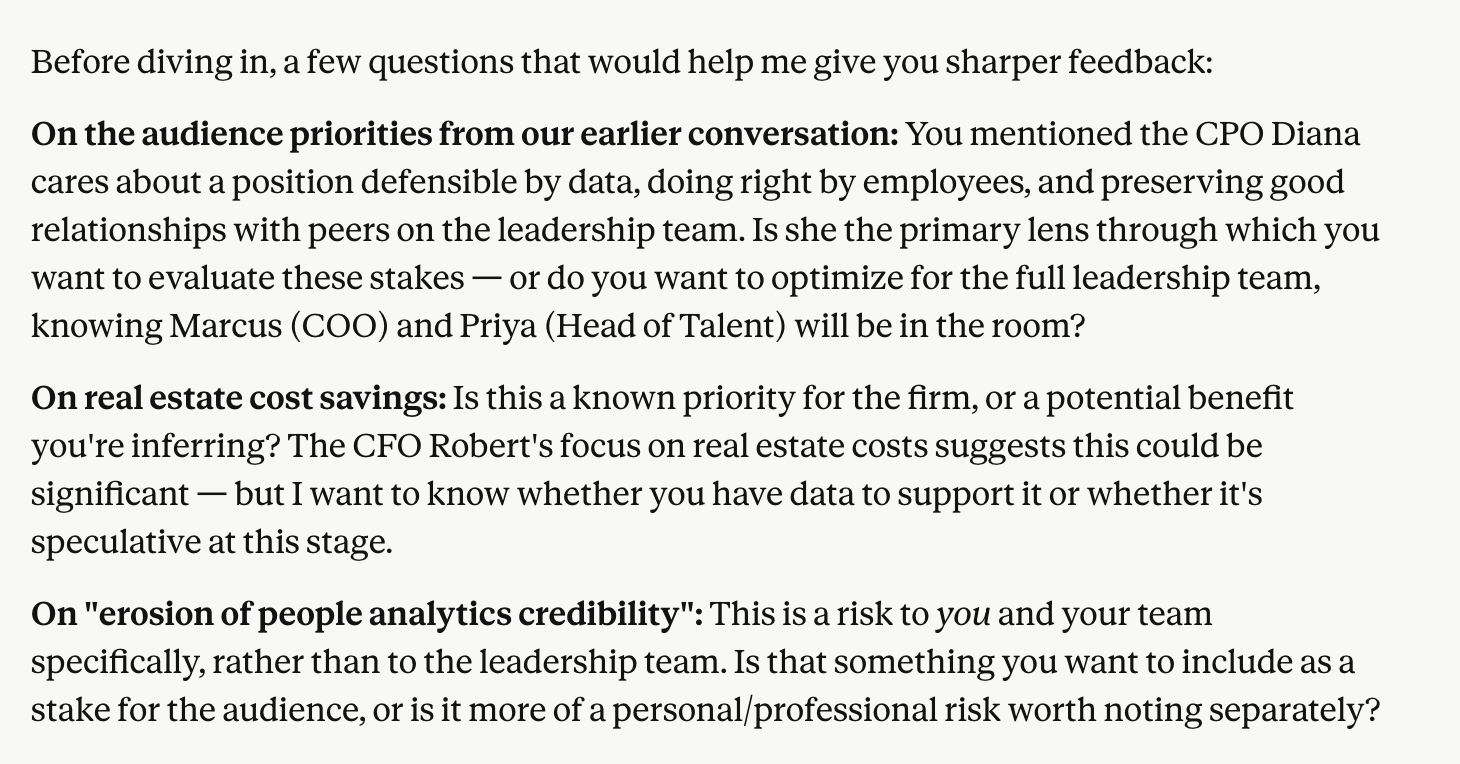
One of the things I’m finding super useful as I work with my AI partner is how clear my thoughts become when I have to form logical answers to questions like this. I clarified that the stakes are going to need to resonate beyond Diana, to the entire leadership team. Marcus, Priya, Robert, and Diana all need a reason to say yes (or at least not block it).
I shared that the real estate savings is a real expectation based on analysis we’ve done, which Robert will respond favorably to. That should make him a strong ally in the room when the conversation takes place, so we’ll need to make sure the finding is clear and defensible.
I also pushed back on the people analytics credibility question—its erosion would be much bigger than just me. If leadership commissions rigorous analysis and then ignores it, it sends a signal about whether the data is truly valued, which has implications far beyond this single policy decision. Claude pushed further, suggesting reframing this risk to something like “undermines data-driven decision making as an organizational practice.”
Then it suggested the following in response to my specific questions:
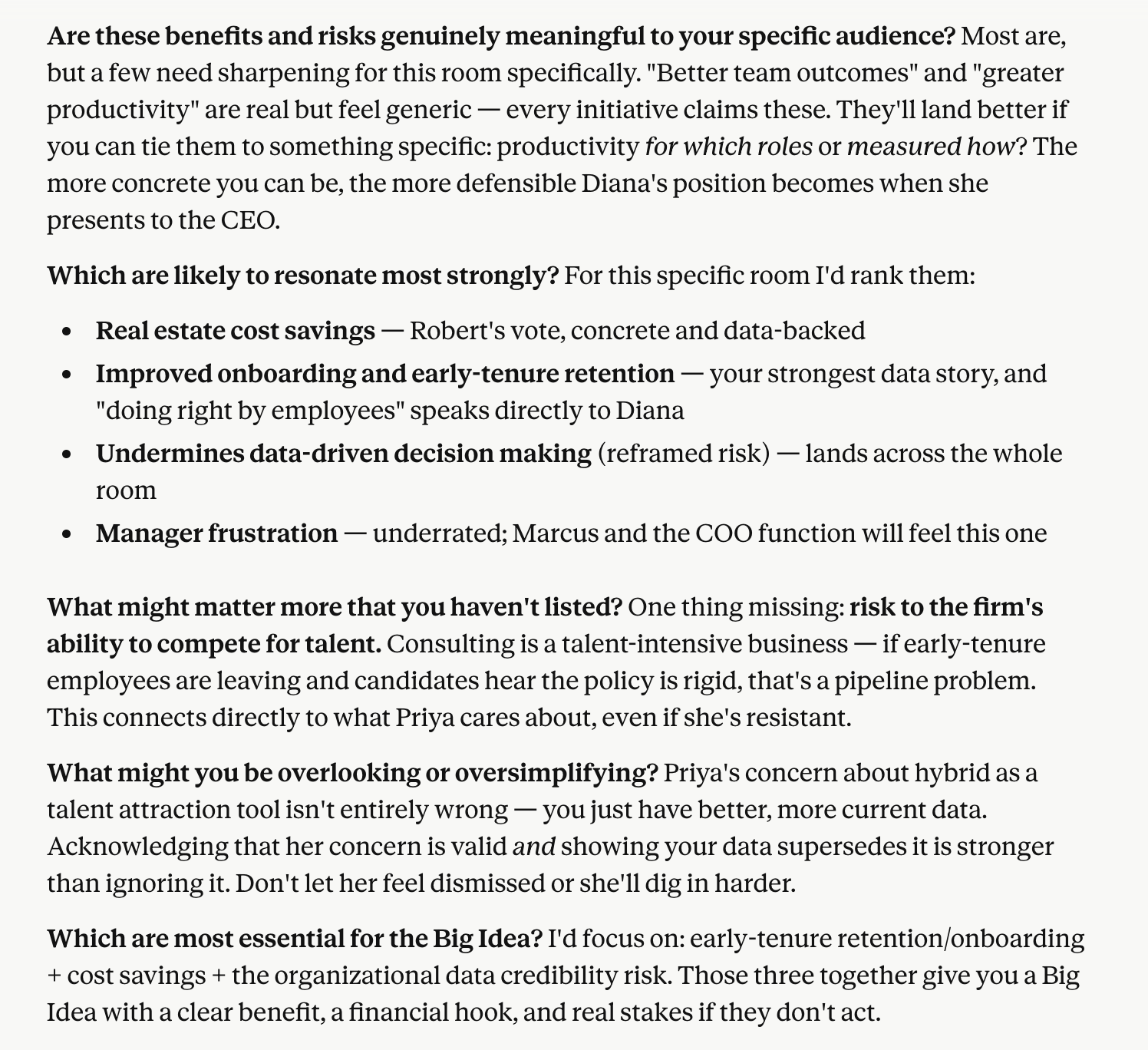
I recognized that greater productivity and better outcomes were vague at best when I wrote them. There is productivity data we could link to in order to make it more real and less jargony, however in seeing some of the other benefits and risks I outlined clearly tied to what individuals in my audience care about, I can see there is likely more compelling data to focus on.
With this in mind, I took a first crack articulating my Big Idea.
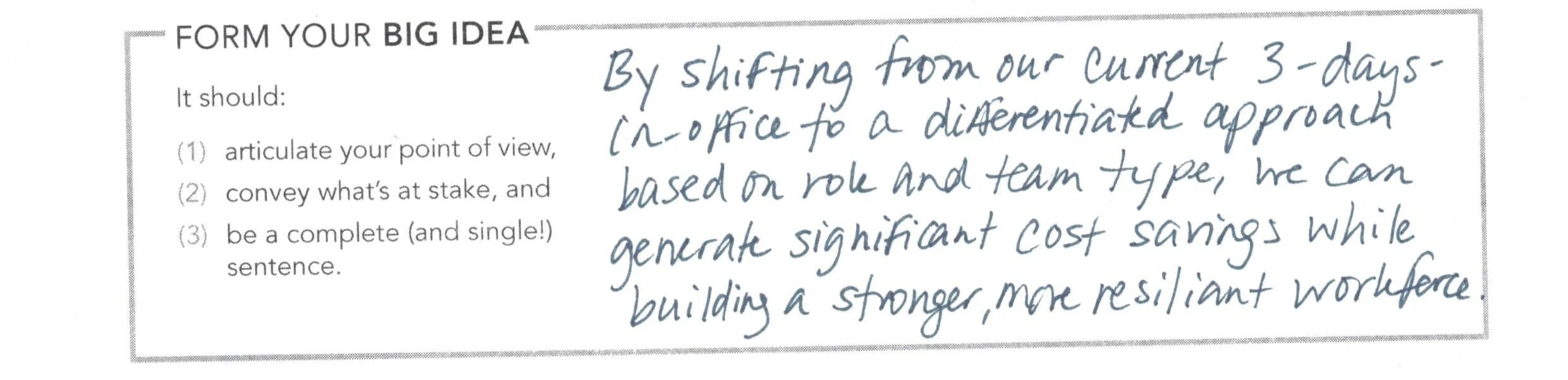
After reflecting on the pilot suggestion, I decided a full change was the stronger recommendation. A pilot would undermine the cost savings argument—you can’t meaningfully reduce real estate footprint on a temporary basis. We’ll keep the pilot framing in our back pocket if there’s significant pushback, but we shouldn’t lead with it. This is a good reminder that AI’s suggestions are starting points, not directives—you should always be the one making the final call.
I provided this detail to AI, along with the questions from potential prompt 3. Here were the initial questions posed to me in response:
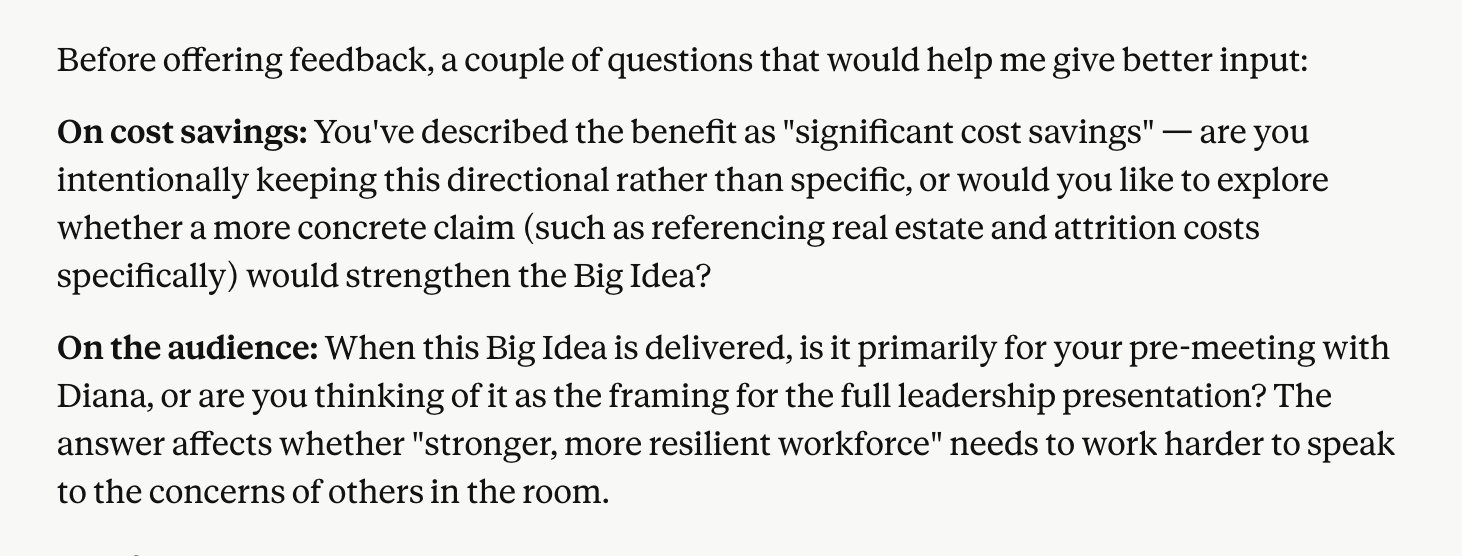
I explained that I intentionally don’t want to anchor people on a specific number. We have analysis on cost savings in terms of real estate and reduced attrition, but there are so many assumptions that go into the latter in particular, that I don’t want to invite people to pick apart the specifics, when the directionality and general magnitude are more important.
I also clarified that the Big Idea will frame my presentation both for Diana and the leadership team. I’m aware that “stronger, more resilient workforce” is a little vague, but I like that it can refer to smoother onboarding, less frustrated managers, and productivity gains—all benefits we expect to reap if this change is made. We’ll go into more details on each of these in the presentation itself.
Here is Claude’s response:
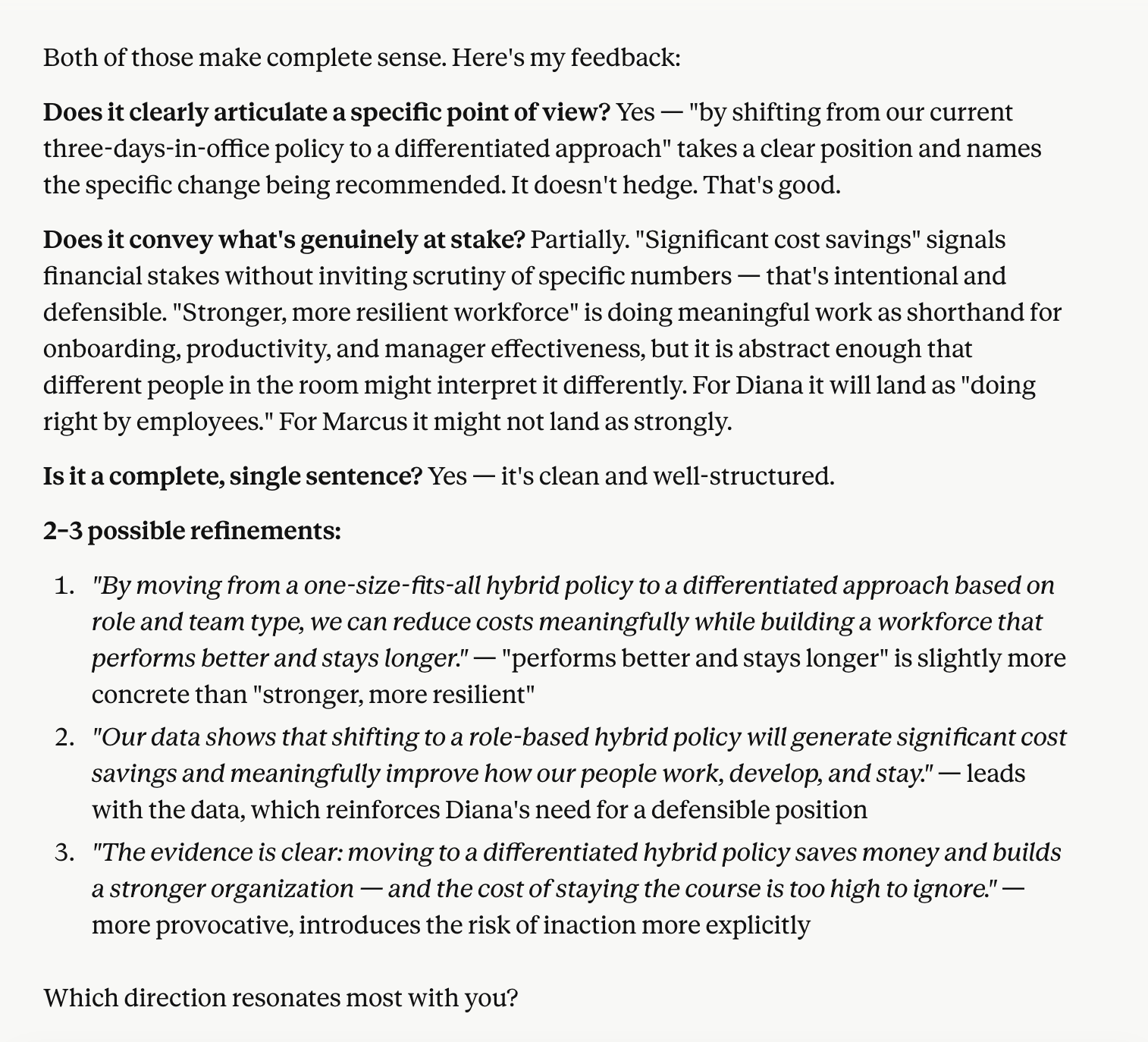
Taking these options together with my initial version, I iterated to:
It’s time to shift from our current three-days-in-office policy to a differentiated approach based on role and team type—one that meaningfully reduces costs and enables people to perform better and stay longer.
Looking back at where I started versus where I landed, the difference is meaningful. I came in focused primarily on Diana and with a muddled action. Working through it with AI pushed me to think about every person in the room, sharpened my understanding of what’s genuinely at stake for each of them, and helped me arrive at a Big Idea I feel confident standing behind. That’s more than I would have worked through on my own in the same amount of time.
In our workshops, we often have participants work through the Big Idea worksheet with a human partner who asks questions, pushes back, and helps you see what you’re too close to notice. What struck me working through this with Claude is how effectively it can play that role. It’s patient, it asks good questions, and—when you direct it well—it helps you think more clearly rather than doing the thinking for you. That’s exactly what AI as a thought partner should be.
Context is the foundation that everything else builds on. Get it right here, and the rest of the process becomes easier.
In the next post in this series, we’ll move to another core SWD skill: crafting a story. In the meantime, watch our live event, where Simon and I explore how to use AI for better data storytelling—including diving deeper into ideas from this series.